
Sellers facing a cash flow crunch between orders will find funding elsewhere, taking their next transaction to whichever rival platform or lender helps them first.
Embedding working capital directly into your B2B marketplace prevents this vendor drift, keeping your users active and protecting your own transaction volume.
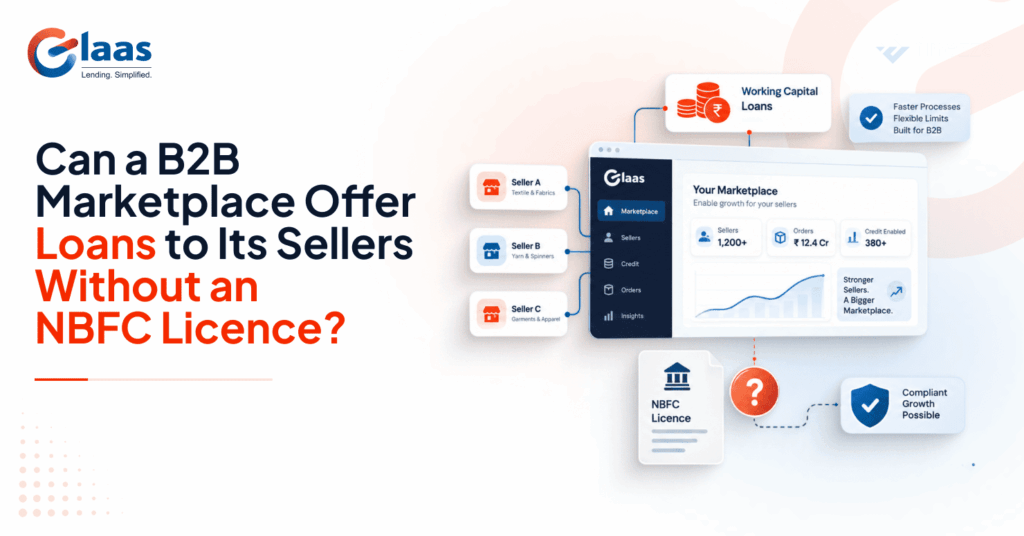
While these projects frequently feel overwhelming due to RBI compliance and the complexities of holding a licence, the regulatory reality is simple: your marketplace does not need to become a lender to offer credit.
Key Takeaways
- A marketplace needs an NBFC licence only if it expects lending to become its principal business, funded from its own balance sheet.
- The route almost every platform takes instead is partnering with a licensed NBFC as a Lending Service Provider, a structure RBI recognises under its Digital Lending Directions, 2025.
- The NBFC remains the lender of record. Loan money moves between the NBFC and the seller’s bank account, never through the platform’s account.
- Credit risk sits with the NBFC unless the platform agrees to a default loss guarantee, which RBI caps at 5% of the loan portfolio.
- What separates partners isn’t the licence they may hold. It’s whether they underwrite on your platform’s data and how fast they can move.
Does a B2B Marketplace Need an NBFC Licence to Offer Credit?
No, as long as it isn’t the one putting up the money.
Section 45-IA of the RBI Act, 1934 requires a company to register before it can carry on the business of a non-banking financial institution. RBI’s test for whether you’ve crossed into that: do more than half your assets and more than half your income come from financial activity? If lending is running alongside your actual business rather than being your actual business, you’re on the right side of it.
A platform extending small amounts of trade credit to a handful of sellers from its own funds is unlikely to be there. A platform funding a standing credit line for every seller on it, out of its own money, qualifies as “financial activity,” no matter what the internal team calls the product. And this isn’t a rule worth testing while you check for demand. Section 58B(4A) makes contravention punishable with a jail term of 1-5 years, plus a fine of ₹1 lakh to ₹5 lakh.
Could a platform just get the licence itself?
It can, but it’s a separate business from the one you already run: fresh capital, a minimum ₹10 crore in net owned funds, paperwork with RBI, and ongoing compliance once you’re registered, not a one-time cost. Practitioners put the full timeline at 8 to 14 months before a rupee gets disbursed.
RBI’s Amendment Directions of 29 April 2026, effective 1 July 2026, make one exemption: NBFCs under ₹1,000 crore in assets that take no public funds and have no customer interface. A marketplace lending to its own sellers has a customer interface by definition, so this exemption doesn’t apply. There’s no small-scale version to start with and grow out of, registration is mandatory regardless of size.
What’s the Alternative, and How Does It Work?
The alternative is to work with a company that already holds the licence and operate under it as its lending service provider.
RBI’s Digital Lending Directions, 2025, effective 8 May 2025, set this structure out formally. A Lending Service Provider acts as agent of a Regulated Entity, which is a licensed bank or NBFC, and handles digital lending functions on its behalf: bringing in customers, supporting underwriting, servicing, monitoring, recovery. All of it under a written contract. The marketplace becomes the LSP. The NBFC stays the Regulated Entity, and it keeps everything that comes with holding a licence.
Worth being clear on one point, because it’s where platforms sometimes assume more freedom than they have: the Regulated Entity stays answerable to RBI for what its LSP does in its name. Outsourcing a function doesn’t outsource the accountability for it.
Who Actually Lends the Money, and Where Does It Go?
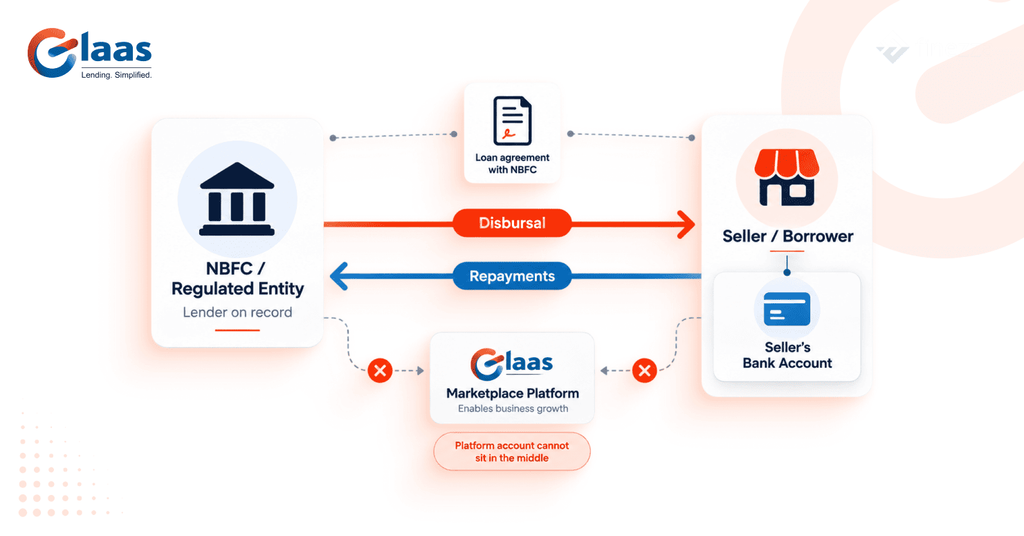
The NBFC is the lender on record, and the money moves directly between the NBFC and the seller’s bank account.
Under the same 2025 Directions, disbursal has to move from the Regulated Entity to the borrower’s account and repayments have to travel back the same way, with narrow exceptions set out in the Directions. The platform’s own account can’t sit in the middle as a pass-through, and the loan agreement the seller signs is with the NBFC.
For the platform, that’s less of a constraint than it sounds. Credit appears inside the seller’s existing experience, on the marketplace’s brand, while the money and the paperwork route around it.
What Should You Check in an NBFC Partner for Embedded Finance?
Establishing the licence isn’t the deciding factor. What separates one partner from another is the operating detail underneath it.
- Underwriting depth: A partner scoring purely off bureau data is offering the same product a seller could get by walking into a bank. Underwriting that factors in GMV, repeat-customer behaviour, bank flow, and months active gets closer to how the seller’s business actually runs.
- Integration speed: A co-branded, no-code product can go live in under 2 days, a fully native integration in around 2 weeks. Match the option to how urgently your sellers need credit, not to which one looks more polished in a demo.
- Contract clarity: RBI’s 2025 Directions expect a written contract with defined roles and responsibilities, backed by proper due diligence between the Regulated Entity and its LSP.
- Balance sheet capacity: A single NBFC’s balance sheet has limits of its own. A partner built to add co-lending relationships later means your seller credit doesn’t get capped by what one lender is willing to underwrite.
This is where GLAAS comes in. It works for the platforms running underwriting on the platform’s own data rather than bureau data alone.
GLAAS has disbursed more than ₹1,500 crore across 110,000+ loans to over 13,000 MSMEs (micro, small, and medium enterprises) through its platform partners, with 7 in 10 borrowers returning for a second loan. Numbers like that are one way to tell whether a partner has run this at scale, not just built the technology for it.
What Your Marketplace Carries, and What It Doesn’t
By default, the credit risk sits with the NBFC. When a seller falls behind, the NBFC’s own collections and recovery process takes over, and it stays off your marketplace’s books unless a default loss guarantee says otherwise.
That default has a qualifier, and any partner who glides past it is selling rather than explaining. Chapter VI of the 2025 Directions permits a Regulated Entity to enter a default loss guarantee arrangement with its LSP, which means a platform can be asked to cover first loss on part of the book. RBI caps that at 5% of the underlying loan portfolio. The LSP offering it has to be incorporated under the Companies Act, 2013. Cover can only be held as cash, a lien-marked fixed deposit, or a bank guarantee. And it has to be invoked within 120 days of an account going overdue.
So the accurate version is: a marketplace can run seller credit with nothing on its own balance sheet, and many do. Whether it carries any first loss is a commercial term someone negotiates, not something the regulation settles for you. Ask about it in the first conversation rather than the fourth.
Where This Leaves Your Platform
A marketplace doesn’t need to become a lender. It needs to choose one. The harder question comes after that: does this partner underwrite on your platform’s own transaction data? Can it approve a seller fast enough to matter, before that seller goes looking elsewhere?
GLAAS is built for that seat. It runs the technology in the LSP layer, and Gromor Finance, its own NBFC, is the Regulated Entity that lends. Platforms go live with a credit product under their own brand, on a no-code embed, in under two days.
If you’re working through this for your own platform, contact us now, and we’ll map what a seller credit line built on your transaction data would look like. No licence required on your end.
Frequently Asked Questions
1. Does a B2B marketplace need an NBFC licence to lend to its sellers?
No, not if it partners with a licensed NBFC instead of lending from its own balance sheet. It operates as a Lending Service Provider, handling seller-facing functions like data sharing and onboarding, while the NBFC extends the credit and carries the risk.
2. When would a marketplace need to register as an NBFC?
Once lending becomes its own principal business: RBI’s test is whether more than half a company’s assets and income come from financial activity. Most platforms offering embedded credit through a partner never cross that line.
3. What is a Lending Service Provider (LSP) under RBI’s rules?
An LSP is an agent that performs functions like customer acquisition, underwriting support, servicing, or recovery on behalf of a Regulated Entity, under a contract. RBI’s Digital Lending Directions, 2025 govern this relationship, and the Regulated Entity stays fully accountable for what its LSP does.
4. What does GLAAS do, and how is it regulated?
GLAAS operates as a Lending Service Provider under RBI’s Digital Lending Directions, 2025. Its NBFC, Gromor Finance, is the Regulated Entity that carries the credit risk, using the marketplace’s own transaction data to underwrite rather than bureau scores alone. GLAAS has disbursed over ₹1,500 crore across 110,000+ loans to 13,000 MSMEs for platforms like Meesho and Razorpay, with seven in ten borrowers returning for a second loan.