
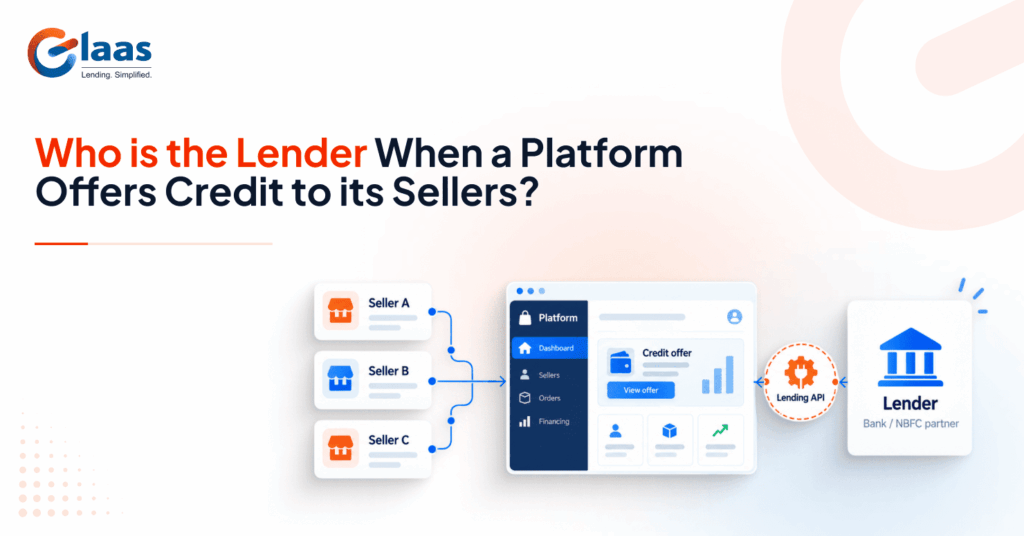
A platform introducing a seller-credit offering inside its existing app needs one question answered before it goes live: when a seller borrows through that offering, who are they really borrowing from?
If the arrangement is set up the standard way, a licensed NBFC is the lender, not the platform. The NBFC approves the loan, disburses it, and carries the risk if the seller doesn’t repay. The platform’s job is to bring the offering to sellers inside its own app and support the NBFC’s process, typically by supplying transaction data that helps it underwrite faster.
That answer settles who lends. It doesn’t settle what the platform itself is responsible for, and that gap is where platforms run into trouble.
Two signs mean the arrangement has drifted from that standard structure, whatever the partnership deck calls it:
- The loan agreement identifies the platform, rather than the NBFC, as the lender.
- Repayments pass through the platform’s own bank account before reaching the NBFC.
Key Takeaways
- The licensed NBFC is the lender of record. It signs the loan agreement, disburses the funds, and carries the credit risk unless it has separately agreed to share part of that risk.
- The platform’s role is that of a Lending Service Provider (LSP), an agent whose specific functions are set by its written contract with the NBFC, not by the LSP label alone.
- RBI’s rules bar the platform’s own account from acting as a pass-through for disbursal or repayment. Both move directly between the NBFC and the seller’s bank account.
- A platform only shares in a seller’s default loss if it has separately agreed to a Default Loss Guarantee (DLG), capped by RBI at 5% of the amount disbursed under that specific loan portfolio.
- Not bearing default loss doesn’t mean the platform has no responsibilities. Under its LSP agreement, it may still handle onboarding, underwriting support, or collections outreach, work that continues whether or not a DLG is in place.
- RBI holds the NBFC responsible for everything its LSP does on its behalf, including the platform’s conduct with sellers.
Does Offering Sellers Credit Make Your Platform a Lender?
No, not when the credit runs through a licensed NBFC partner. The loan stays on the NBFC’s books because the NBFC is the one that approves it, signs for it, and funds it from its own balance sheet. The platform just connects the seller to the NBFC and supports the process along the way, without extending the credit itself.
On the flip side, a platform lending on its own account would need to register as an NBFC. Registration turns on how much of a company’s business is financial in nature, measured by the share of its total assets and gross income coming from financial activity, not by whether it uses its own funds.
Who is a Lending Service Provider Under RBI’s Rules?
A Lending Service Provider, or LSP, is RBI’s term for an agent that carries out specific lending functions on behalf of an NBFC, under a written contract between the two. The Reserve Bank of India (Non-Banking Financial Companies – Credit Facilities) Directions, 2025 set this structure out in Chapter III.
A platform becomes that agent by taking on one or more functions under its contract with the NBFC, such as bringing in customers, supporting underwriting, servicing a loan, or helping with recovery. Which functions it actually performs is set by that contract, not assumed from the LSP label.
What doesn’t move, regardless of the contract, is the lending decision itself: the NBFC underwrites and approves each loan, and a platform doesn’t take on credit risk simply by performing these functions well. Taking on part of that risk needs a separate written arrangement, covered further down.
Who Signs the Loan Agreement, and Where Does the Money Move?
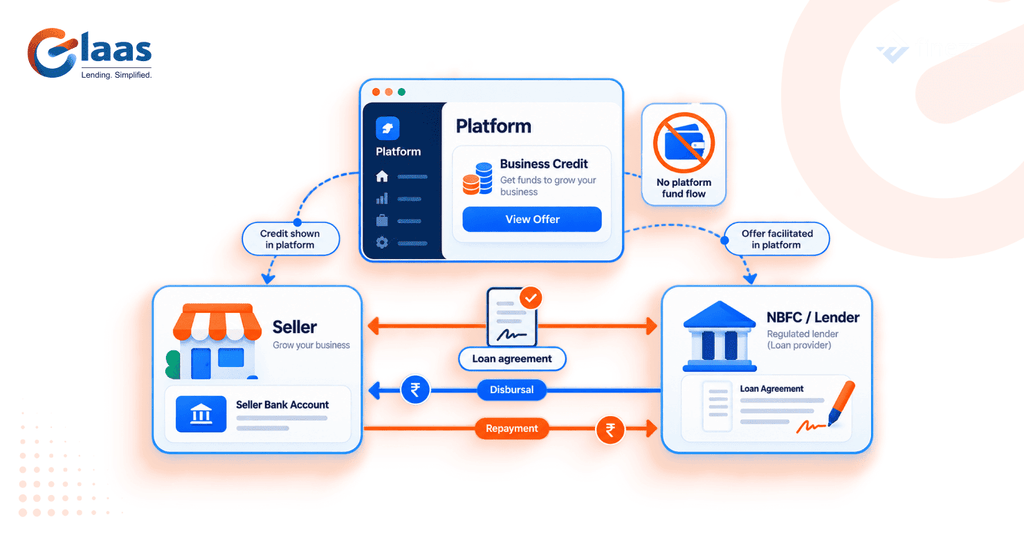
Two things happen in this arrangement, and they’re worth keeping apart: who the seller’s loan agreement is with, and which bank accounts the money moves through.
The seller signs the loan agreement with the NBFC. RBI’s rules require this document to name the actual lender, not the platform the seller uses day to day.
Money follows the same principle: the NBFC disburses funds directly into the seller’s bank account, and the seller repays the NBFC the same way. RBI’s rules bar the platform’s own account from acting as this kind of pass-through, or pool account, for either leg, with narrow exceptions such as co-lending.
None of this stops a platform building the experience inside its own interface. A seller can see an offer, work through the paperwork, and track repayments without leaving the platform’s app, under the platform’s own branding. What’s shown on screen is a design choice, separate from who’s lending and where the money moves; both stay directly between the seller and the NBFC.
What Happens If a Seller Misses a Repayment?
A missed payment, an account moving into collections, and a realized default loss are different points on the same timeline, and RBI treats them differently.
When a seller misses a payment, the NBFC’s collections process takes over first, sometimes run through the platform acting as its LSP under specific written instruction. If the seller still hasn’t caught up, RBI requires the NBFC to invoke any agreed Default Loss Guarantee within a maximum overdue period of 120 days, rather than waiting for a formal write-off.
Whichever point it’s resolved at, the underlying loss falls to the NBFC by default: it’s the lender of record, and it absorbs a seller’s default unless it has separately agreed to share part of that loss.
A platform can take on part of that loss only through a separate, explicit Default Loss Guarantee, or DLG, under which it commits upfront, as the NBFC’s LSP, to compensate the NBFC for a defined share of losses on a specific loan portfolio.
Not every platform qualifies: RBI requires a DLG provider to be incorporated as a company, and the NBFC must complete its own eligibility and due-diligence checks before entering the arrangement. RBI also caps the cover itself: under Chapter III of the Directions, a DLG can’t exceed 5% of the amount disbursed under the specific portfolio it covers, tracked at any given point in time, not 5% of the platform’s total book.
A platform without a DLG doesn’t inherit any of this by default. One that has signed a DLG takes on a defined, capped share of losses on the named portfolio, nothing broader.
What Should You Confirm With a Lending Partner Before You Go Live?
These four checks are worth running through with any NBFC partner before a seller credit offering goes live.
1. Role and Paperwork
Confirm the written contract required under RBI’s rules spells out which functions the platform performs (sourcing, underwriting support, servicing, recovery) and which stay with the NBFC. An agreement that doesn’t name these clearly leaves both parties guessing who’s accountable if RBI, or a seller, raises a complaint.
2. Loan Agreement Ownership
Check who’s named as the lender on the loan agreement itself, and how the platform’s own role is described elsewhere in the document. If either is unclear, or the platform is described in a way that could read as a lending party, that needs fixing before launch, not after a regulator or a seller raises it.
3. Money Flow
Ask which bank accounts disbursement and repayment move through, on both sides of the transaction. Funds routing through the platform’s own account, even briefly, is a pass-through arrangement RBI’s rules don’t permit for a standard NBFC-LSP structure, and it’s worth catching at the contract stage rather than after go-live.
4. Default Handling
Ask two separate questions: who follows up when a seller misses a payment, and whether the platform has agreed to a Default Loss Guarantee. If a DLG is part of the deal, get the exact loan portfolio it applies to and the percentage of that portfolio’s disbursed amount it covers, in writing, rather than a general sense of “coverage.”
Where This Leaves Your Platform
A platform offering seller credit through a licensed NBFC doesn’t need to become a lender to keep sellers funded and orders flowing. What it needs from a partner is paperwork that matches that structure: the NBFC’s name on the loan and its account handling the money, with default terms already agreed before a seller ever misses a payment.
GLAAS builds that structure for digital platforms. In the arrangement this article describes, Gromor Finance, GLAAS’s own licensed NBFC, is the lender, underwriting off the platform’s own transaction data rather than relying on bureau scores alone. Other GLAAS arrangements may involve additional regulated lenders as co-lending partners. Platforms have gone live with a co-branded, no-code credit product in under two days, and seven in ten GLAAS borrowers come back for a second loan.
If you’re weighing this for your own platform, talk to GLAAS about what a seller credit line built on your transaction data would look like.
Frequently Asked Questions
1. What is a lending service provider (LSP) in India?
An LSP is an agent that carries out specific digital lending functions, such as customer acquisition or loan servicing, on behalf of an NBFC, under a written contract. RBI’s Non-Banking Financial Companies – Credit Facilities Directions, 2025 govern this relationship.
2. Is a platform considered the lender when it offers credit through a licensed NBFC partner?
No. In this arrangement, the NBFC is the lender of record. It signs the loan agreement, disburses the funds, and carries the credit risk by default. The platform acts as the NBFC’s agent, not as a party to the loan.
3. Does a platform need an RBI licence to work with a lending service provider structure?
A platform does not need its own NBFC registration for the licensed-partner arrangement described here. A different lending model needs a separate assessment under RBI’s rules.
4. What happens if a seller misses a repayment under this structure?
The NBFC’s collections process runs first, sometimes through the platform acting as its LSP. If the loan isn’t recovered, the resulting loss stays with the NBFC by default, unless it has separately agreed to a Default Loss Guarantee (DLG) with the platform, capped by RBI at 5% of the amount disbursed under the specific loan portfolio the DLG covers.
5. What does GLAAS do, and how is it regulated?
GLAAS builds the technology that lets digital platforms embed seller credit inside their own apps, using each platform’s transaction data to underwrite. In this arrangement, Gromor Finance, GLAAS’s own licensed NBFC, is the lender; other GLAAS arrangements may involve additional regulated lenders as co-lending partners.