

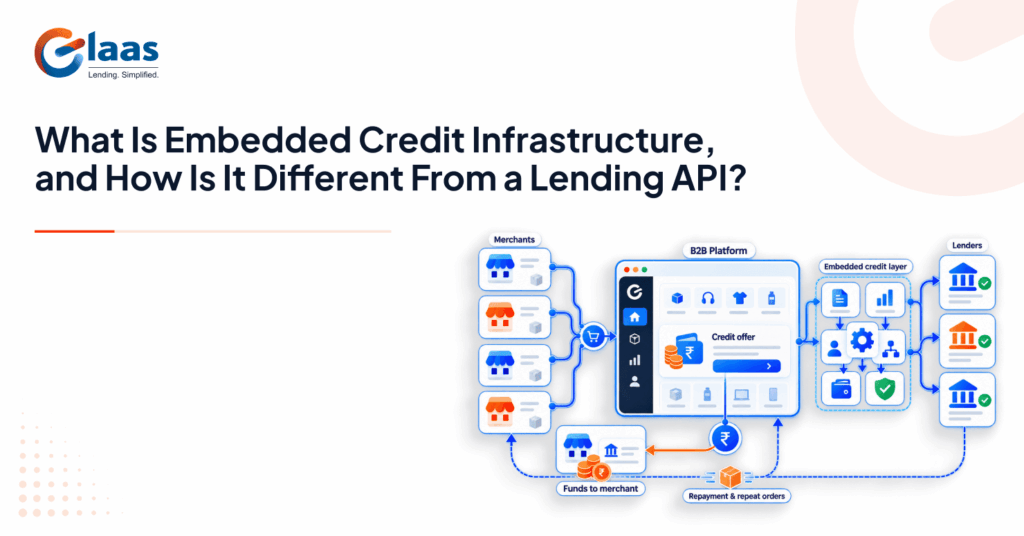
Embedded credit ≠ Lending API. Some providers use these two terms interchangeably. They don’t mean the same thing.
A lending API is the connection between your platform and a lender’s system. Embedded credit infrastructure is everything required to run a credit product around that connection.
That distinction comes down to 4 things: who decides which merchants qualify, what credit product they receive, who the licensed lender is, and who manages the merchant journey after disbursement.
Merchants on B2B platforms need working capital between orders. When a platform doesn’t offer it, they find it elsewhere. That outside financial relationship gradually pulls engagement away. The distinction between a lending API and embedded credit infrastructure determines how much of that credit product a platform actually controls.
Key Takeaways
- A lending API is a data connection between your platform and a lender’s system. It sends application data and returns a result.
- Embedded credit infrastructure is the broader setup around that connection. It can cover underwriting, product configuration, a licensed lending entity, the merchant-facing experience, and what happens after disbursement.
- The practical difference is who handles what: who makes the credit decision, who sets the product terms, where the merchant applies and repays, and who manages collections.
- The word “API” describes a connection method, nothing more. It tells you nothing about how the provider underwrites, what product they offer, or what happens once a loan is disbursed.
What Does a Lending API Do?
A lending API is a software connection between your platform and a lender’s loan origination system. When a merchant applies for credit, your platform sends their application data through the API. The lender’s system processes it and returns a result: approved, declined, or flagged for manual review.
Data moves between the two systems without the platform needing to build its own origination system. The API doesn’t determine how the lender makes the credit decision, what product they offer, where the merchant completes the application, or who handles collections after disbursement. Those depend on the lender or provider, and they vary significantly from one provider to the next.
Some platforms find this sufficient when the goal is connecting merchants to external funding. Others need more control over underwriting, product design, merchant experience, or post-disbursement operations.
What Does Embedded Credit Infrastructure Actually Add?
Embedded credit infrastructure is the assembled setup that lets a platform offer credit as a native product, without building an underwriting team, holding a balance sheet, or applying for a lending licence.
The API is one component. 4 decisions determine everything else: who underwrites, what product gets offered, who the licensed lender is, and who manages repayment. Here’s what each one involves.
1. Who Decides Which Merchants Qualify?
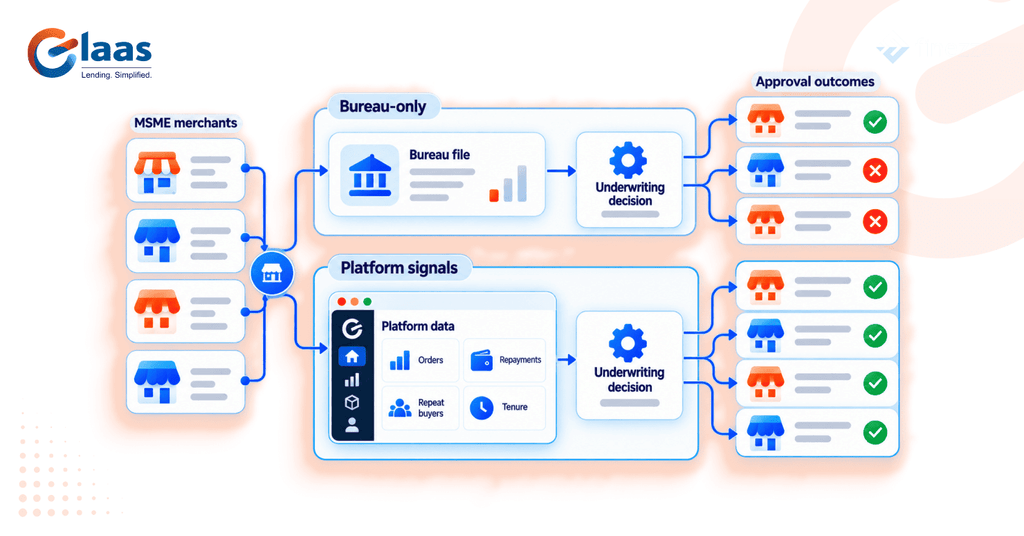
In a properly built embedded model, the underwriting engine can incorporate transaction data from the platform itself: a merchant’s order volumes, payment behaviour, months of active trading, average basket size. If a merchant has bought and paid reliably on your platform for two years, that trading history is useful credit information even if their bureau file is thin.
Bureau data and platform data work together rather than replacing each other. For platforms where many merchants are first-time formal borrowers, the ability to incorporate platform signals changes who qualifies.
2. What Credit Product Can be Offered?
A textile marketplace and a pharmaceutical distributor have different cash-flow cycles and very different borrowing needs. A configurable product setup means loan amounts, tenors, and repayment structures can be set to match the platform’s specific merchant base, rather than applying one standard product across all borrowers.
3. Who Actually Lends the Money?
Credit disbursement in India requires a licensed bank or RBI-registered NBFC to release funds. In a full embedded setup, the licensed lender is already part of the arrangement, either as an entity the provider owns or through a partnered bank or NBFC. The platform does not need to become a lender itself.
4. Who Manages the Merchant Journey and Repayment?
In an embedded setup, the merchant’s experience, from application through repayment, can stay inside the platform. Collections, repayment tracking, and delinquency monitoring are the provider’s responsibility. The platform gets visibility through a dashboard rather than inheriting the operational load.
Embedded Credit Infrastructure vs a Lending API: How The Two Compare
| Standard API arrangement | Full Embedded Credit Setup | |
| Credit decision | Usually controlled by the lender | Can incorporate platform data and configurable underwriting |
| Credit product | Often lender-led | Can be configured around the platform’s merchant base |
| Merchant experience | May redirect or use a co-branded flow | Can remain inside the platform |
| Licensed lender | May need a separate lender relationship | Included in the overall setup |
| Post-disbursement | Usually lender-led | Can include platform visibility, monitoring and lifecycle support |
Why the Difference Matters in Practice
Approval Coverage
A lender that relies heavily on bureau data may struggle to assess merchants with limited formal borrowing history, even if those merchants have traded reliably on your platform for years. An underwriting model that incorporates platform signals changes who qualifies.
Merchant Experience
Under a standard API arrangement, the merchant is redirected to the lender’s interface to complete the application and manage repayment. Under a fully embedded setup, the merchant can complete the credit journey without leaving your platform, while the regulated lending remains with the licensed lender.
Product Fit
A working capital loan structured for a twelve-week textile sourcing cycle won’t serve a dealer who needs a six-month equipment financing arrangement. Configurable product terms, set in collaboration with the provider, mean the credit product fits how the platform’s merchants actually trade.
Visibility After Disbursement
Under a standard API setup, collections belong to the lender and the platform has limited sight of which merchants are struggling until it shows up in their trading behaviour. A full embedded setup can also give the platform ongoing visibility through portfolio dashboards, repayment monitoring and early-warning signals on at-risk accounts.
For more on how the regulatory side of embedded credit works for platforms, see our piece on finding the right lending partner for embedded finance.
How GLAAS is Set Up
Here’s how GLAAS’s model works.
- Credit decision: GLAAS’s underwriting engine incorporates platform transaction data alongside bureau data, helping assess merchants with limited formal borrowing history using a broader set of signals.
- Credit product: GLAAS offers 25+ configurable credit products. Loan amounts, tenors, and repayment structures can be tuned to a platform’s merchant base rather than applied uniformly.
- Merchant experience: GLAAS supports white-label and native journeys so merchants apply and repay without leaving the platform.
- Licensed lender: GLAAS operates through Gromor Finance, its RBI-licensed NBFC. Platforms integrating with GLAAS don’t need their own lending licence or capital commitment.
- Post-disbursement: Collections, repayment monitoring, and portfolio reporting run through GLAAS, with live dashboard access for the platform.
GLAAS has funded 110,000 loans to 13,000+ MSMEs served across India. Seven in ten return for another loan. A co-branded setup goes live in under 2 days; a fully native integration in under 2 weeks.
Evaluating how to add credit to your platform? Talk to GLAAS →
Frequently asked questions
1. Is a lending API the same as embedded credit?
No. A lending API is a data connection: it sends a merchant’s application to a lender and returns a result. Embedded credit is the broader setup around that connection, covering underwriting, product configuration, the merchant journey, and what runs after disbursement. The API is one component inside a full embedded credit setup.
2. Does a platform need its own NBFC licence to offer credit to its merchants?
No. In an embedded model, the platform facilitates access to credit; it doesn’t lend. Lending is done by a licensed bank or RBI-registered NBFC that is part of, or partnered with, the provider. GLAAS operates through Gromor Finance, its own licensed NBFC, so platforms integrating with GLAAS don’t need to source a lender separately.
3. How does platform transaction data improve credit decisions?
Bureau data reflects a merchant’s formal borrowing history. Platform data reflects how they actually trade: order volumes, payment reliability, months of active trading. For merchants with thin bureau files who trade reliably on a digital platform, incorporating platform data can change whether they qualify.
4. What happens to collections and repayments under an embedded credit model?
The licensed lending entity manages collections. In a full embedded setup, the provider can also run post-disbursement monitoring, repayment tracking, and early warning on at-risk accounts. The platform has visibility through a dashboard but doesn’t run the collections operation.
5. What does GLAAS provide, and who is the regulated entity?
GLAAS is an embedded credit infrastructure provider for B2B digital platforms in India. It brings underwriting technology that incorporates platform transaction data, 25+ configurable credit products, a merchant experience that can stay inside the platform, and lifecycle management after disbursement. The regulated lending entity is Gromor Finance, an RBI-licensed NBFC owned and operated by GLAAS.