
This is my third article in the series of Category erosion and resultant implications. In the first, I introduced the concept of Category Erosion leading to a potential banking meltdown. In the second article, discussed potential consequences of such a category erosion. In this article, I will explain how this leads to inevitable re-engineering of the organisational pillars.
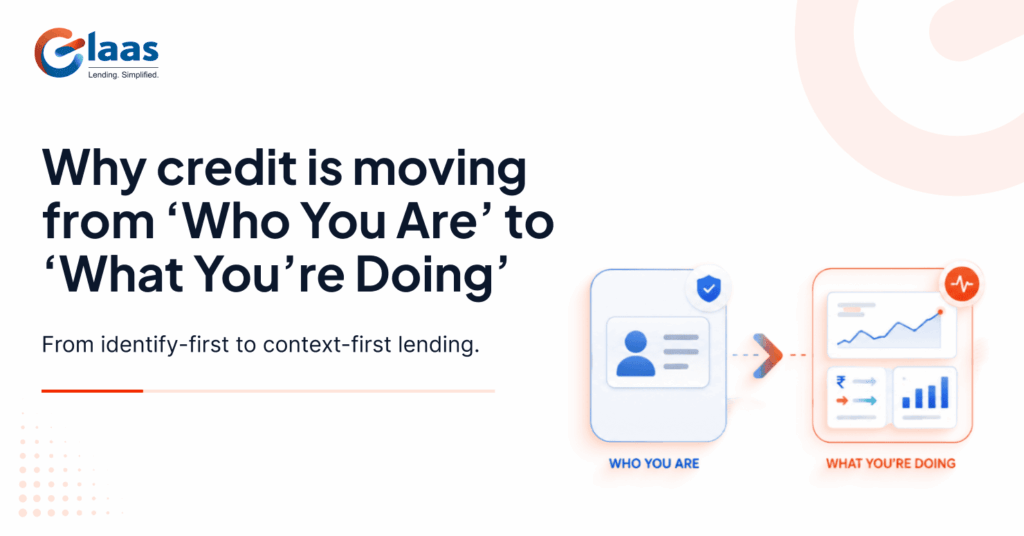
In legacy banking, identity was destiny.
If your identity was a “Retail Salaried Individual,” you were routed to a specific branch manager, given a standard CIBIL-based credit card, and served quickly.
If your identity was a “Private Limited MSME,” you were sent to a commercial relationship manager, asked for 3 years of audited financials, and had to wait for days or weeks.
But now, in a Context-First world, the labels don’t matter. What matters is what the business is doing at the exact moment it needs capital.
An MSME ordering inventory on a B2B marketplace at 11:00 PM needs a ₹4 lakh checkout credit line at the time. If they have to go elsewhere, to prove their “Corporate Identity” to a bank, the transaction never happens, they order less or find alternate avenues.
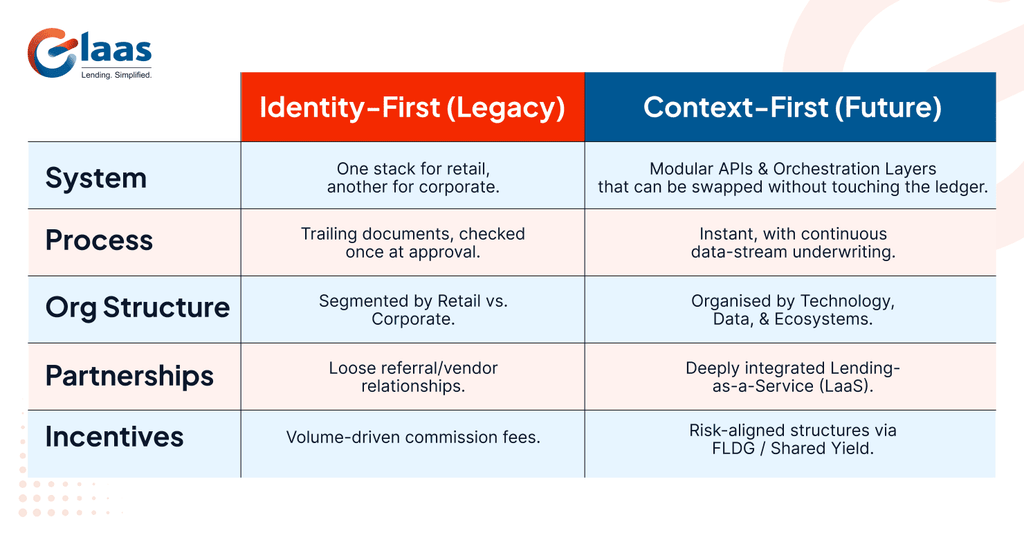
To build a financial institution or fintech suitable for a context-first, identity-second world, you have to fundamentally re-engineer five pillars: Systems, Processes, Org Structure, Partnerships, and Incentives.
System Design: From Product Silos to Unified Ledger & API Mesh
Traditional banking systems are vertical stacks (a core banking system for retail, a separate one for corporate). A context-first architecture must be horizontal and decoupled.
You need a Three-Tier Architecture:
- The Product & Compliance Engine (Backend): The regulated balance sheet and ledger.
- The Orchestration Layer (Middle): Where the rules live. This layer takes incoming data from any context, translates it, and decides the risk profile in real-time.
- The API Mesh (Frontend): Highly modular, plug-and-play APIs that can be embedded into an accounting software, an e-commerce platform, or a logistics app seamlessly.
But, unified and decoupled systems only help if what runs through them changes too.
Process Design: From Static Gatekeeping to Continuous Underwriting
Legacy processes rely on static checkpoints (e.g., “Upload your ITR here”). Context-first processes rely on continuous, permissioned data streams.
- The Real-Time Funnel: Instead of a loan application form, the process is an automated data handshake.
- When a merchant applies for credit within a supply-chain app, they click “Allow Access.” The system pulls real-time transaction history via APIs (like account aggregators or GST networks), runs it through a programmatic underwriting engine, and assigns a dynamic limit in seconds.
Org Structure: From Customer Segments to Capability Tribes or PODs
If your bank’s organisational chart has a “Head of Retail” and a “Head of Corporate” who don’t speak to each other, you cannot execute a context-first strategy.
- The Cross-Functional Shift: Organisations must restructure into Capability-Based Tribes. Instead of segmenting by the type of customer, teams should be organized around ecosystems:
Once the above is in place, the question arises: who’s on the other side of that integration.
Partnership Strategy: From Vendor/Referral to Embedded Co-Alliance
In a context-first world, banks lose direct access to the customer interface. Therefore, your partner (the platform where the context happens) is no longer just a “sourcing vendor” or a Business Correspondent, they are an essential component of the infrastructure.
- The Co-Alliance Model: Lenders must deeply embed themselves into the B2B/B2C platforms. The platform provides the context and rich data, while the financial institution provides the balance sheet and compliance framework.
5. Incentive Design: Moving from Origination Volume to Portfolio Health
This reminds me of Charlie Munger’s words: ‘Show me the incentive, and I will show you the outcome’. If the platform hosting the context is only incentivised on how many loans are disbursed, they will push for volumes. Now, how many of those are bad, that’s a risk to the lender.
- Structuring the Alignment: RBI’s FLDG (First-Loss Default Guarantee) exists for this very reason.
- The Shared Outcome: This completely aligns incentives. The platform is incentivised to maintain high-quality user engagement and clean data, while the funding lender is incentivised to provide lower interest rates and higher approval limits because their downside risk is protected by the context-owner’s skin in the game.
In Summary: This is What the Shift Looks Like
None of this needs a five-year transformation programme. Most of it is a series of decisions about who does what, and who gets paid for which outcome.
The businesses stopped fitting the categories a while ago. The question is how long the categories hold out.
If you’re building on either side of this, I’d be curious which pillar you think is hardest. My guess is the last one.