
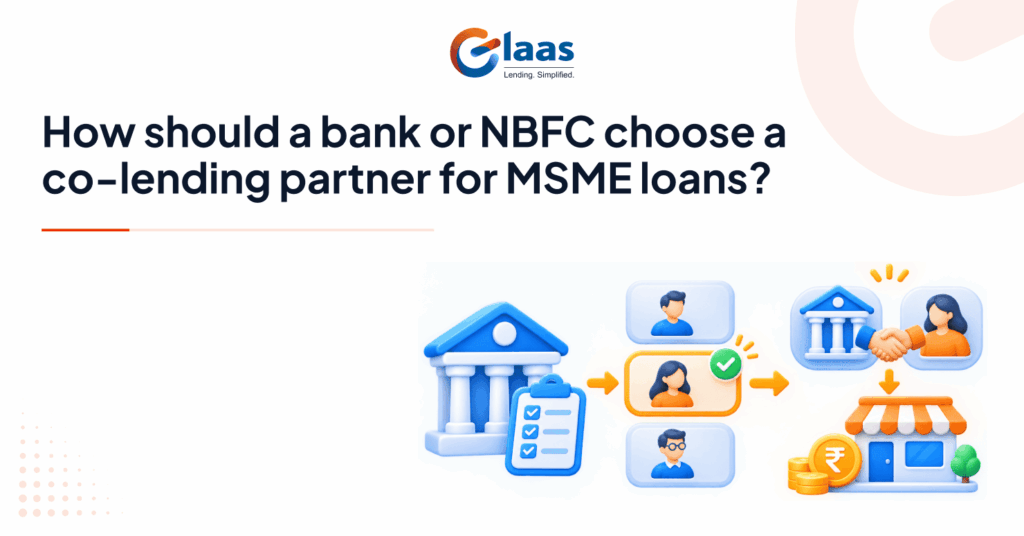
MSME lending is hard to scale alone. Ticket sizes are small, borrowers are dispersed, and distribution costs time and capital before the book earns anything. Co-lending offers another route: a second regulated entity originates the loan, both of you fund it in a fixed proportion, and both carry part of the risk. The agreement may give you origination or servicing capacity you haven’t built. What you don’t gain is distance from the credit decision: you remain exposed to credit risk on your share of the loan.
Choosing the right partner matters as much as agreeing on the funding split. Funding shares, risk sharing, fees and servicing are fixed before the first disbursement and govern the book to maturity.
Key Takeaways
- Each regulated entity must keep at least 10 per cent of every loan on its own books.
- The partner’s commitment to its agreed share, once named at sanction, is irrevocable.
- Repeat borrowing can indicate demand, but does not establish credit quality.
- Vintage loss curves, DPD trends, GNPA, NNPA, write-offs and recoveries each show a different part of portfolio performance.
What is a co-lending arrangement under RBI rules?
RBI’s co-lending requirements, effective January 1, 2026, are now included in Part B of its Transfer and Distribution of Credit Risk Directions, 2025, issued separately for commercial banks and NBFCs.
Two regulated entities agree to fund loans in a fixed proportion and share the income and risk on each loan. Secured and unsecured lending both qualify, and an eligible loan’s bank share can count towards priority sector targets. The rules require:
- Each entity keeps a minimum 10 per cent of every individual loan, tested loan by loan.
- The partner is named in the Key Facts Statement at sanction; its commitment to take its agreed share is irrevocable.
- Both shares appear on both sets of books within 15 calendar days of disbursement.
- The borrower pays one blended rate, weighted by each lender’s share.
- Disbursements and repayments pass through an escrow account with a bank.
- If either lender classifies its exposure to a borrower under the co-lending arrangement as SMA or NPA due to overdue payments, the other must apply the same classification. The information must be shared on a near-real-time basis, no later than the end of the next working day.
- Any default loss guarantee is optional, comes only from the originating entity, and is capped at 5 per cent of loans outstanding.
The rules don’t assign servicing, collections, reporting or recovery; the agreement must cover who does what, alongside eligibility, fees and grievance handling.
How should lenders evaluate a co-lending partner’s sourcing capabilities?
Ask for the whole funnel, not just the top: businesses transacting on the partner’s channels, those meeting the lending rules, those applying, and those approved and disbursed. Actual disbursements are a more concrete measure of origination capacity. The earlier stages indicate potential sourcing reach, while disbursements show actual origination. Heavy channel traffic doesn’t mean many bankable loans follow. Also ask what share comes from the single largest channel.
Before signing, walk through one real day of reconciliation and ask for a sample loan-level MIS report; your provisioning and auditors depend on the partner’s numbers.
How should banks evaluate a co-lending partner’s underwriting?
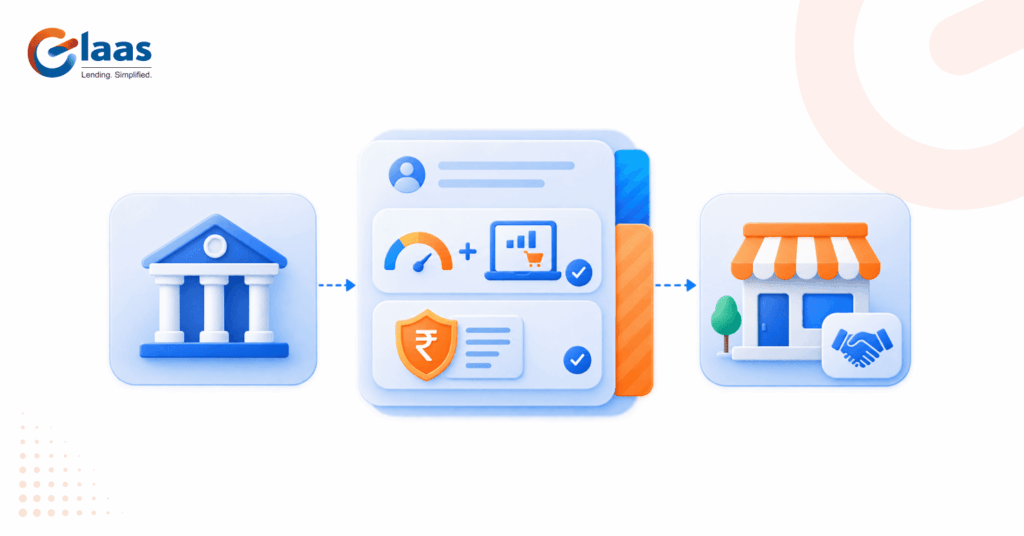
Partners lead with their data. Platform records, GST filings and bank statements can support credit assessment for a business with little bureau history, but they don’t by themselves establish creditworthiness. The quality of those credit decisions must then be assessed through actual loan performance. Ask about those decisions:
Who sets the credit policy?
Your own credit policy must cover co-lending; adopting the partner’s isn’t an option. Agree eligibility, size and tenor caps, excluded sectors, pricing, and who can change them.
How is the underwriting model validated?
Ask which borrower details carry real weight, how often the model is tested against loans that have since repaid or defaulted, and when it was last revised.
How is platform data verified?
Because platform data may come from a commercially interested party, lenders should verify it against independent sources. So ask how it’s checked against independent sources like bank statements or GST returns.
How are exceptions and overrides handled?
Some loans get approved outside standard rules by a person, not the model. Ask what share this is, who signs off, and how those loans performed.
What portfolio evidence shows
A partner’s deck opens with volume: amount disbursed, loans funded, approval speed. That’s activity, not repayment.
Repeat borrowing is sometimes presented as evidence of underwriting quality, but cannot establish it on its own. A repeat-loan rate counts borrowers who came back, reflecting demand and the partner’s appetite to lend again; it says nothing about those who did not return, defaulters included.
Ask instead for:
- Vintage loss curves, grouping loans by month of disbursement and tracking losses as each group ages, so you compare loans at the same age.
- Delinquency by DPD bucket, as a trend across quarters rather than a single snapshot.
- GNPA and NNPA, alongside write-offs and recoveries, to assess asset quality, realised losses and collection outcomes.
- The same figures by channel and segment, since a blended average can hide a weak channel.
None of this measures underwriting alone; servicing, collections and borrower conditions shape outcomes too. And a fast-growing book can show low delinquency simply because its total is weighted towards recent loans that haven’t had time to default; vintage curves correct for this.
Will the arrangement pay for itself?
Your share of each loan sets both the interest you earn and the loss you absorb; the two cannot be priced separately. The borrower pays one blended rate, so a higher rate from one partner can make the blended borrower rate less competitive.
Where the originating entity provides sourcing or servicing, the agreement may provide for separate fees. These must be considered alongside interest income, funding costs and expected credit losses when assessing net returns.
For expected loss, use the partner’s vintage data for the channel you’re buying, not its portfolio average, then find the loss rate where your return on capital drops below what the deal must earn. The gap to actual cohort losses is your margin for error.
Co-lending partner evaluation checklist
| Evaluation area | What to check | Why it matters |
| Strategic fit | Your co-lending limit and target segment against the partner’s loan sizes | A mismatch is hard to unwind later. |
| Sourcing | The funnel down to disbursed loans, and share from the largest channel | Volume at the top isn’t loans at the bottom |
| Underwriting | Who controls the lending rules, how platform data is verified, exception volumes | Credit quality depends on who enforces the rules. |
| Portfolio | Vintage loss curves, DPD trend, GNPA and NNPA, write-offs and recoveries, by channel | Shows how loan performance varies across channels. |
| Economics | Blended rate at the split, servicing fees, expected loss from matching cohorts, break-even loss rate | A well-underwritten loan can still be unprofitable. |
| Operations | A day of reconciliation, sample reporting, classification handoff, audit access | Your reporting and provisioning depend on the partner’s systems. |
| Compliance | Agreement coverage, KYC reliance, who publishes which disclosure | Duties cannot be delegated. |
Where this leaves a bank or NBFC choosing a partner
A large sourcing network isn’t a weakness by itself, but it isn’t sufficient either. A suitable partner should demonstrate portfolio performance, clear credit-policy responsibilities and reliable reporting, alongside its sourcing capabilities.
GLAAS works with banks and NBFCs on co-lending through Gromor Finance, sourcing MSME borrowers from the platforms it is integrated with and running the loan lifecycle. It has disbursed ₹1,500 Cr+ across 110,000 loans funded, with 7 in 10 borrowers returning for a further loan.
Talk to the GLAAS co-lending team about MSME loans sourced from its platform network.
Frequently asked questions
1. What is the minimum share a bank or NBFC must retain in a co-lending arrangement?
Each regulated entity must keep at least 10 per cent of each individual loan on its own books. The test applies to every loan, not the portfolio average, and binds both sides.
2. What happens if the partner’s share is not transferred within 15 calendar days?
Both shares must appear on both sets of books within 15 calendar days of disbursement. If the originating entity cannot transfer the agreed share in time, the loan stays on its books and can only be sold under the loan transfer rules, a different transaction from co-lending.
3. Is a default loss guarantee required, and what is the limit?
No. A guarantee is permitted, not required, and only the originating entity may give one, capped at 5 per cent of loans outstanding. Default loss guarantee, DLG, is RBI’s own term; whatever the paperwork calls it, including the industry term FLDG, the same conditions on cap, source and form apply.
4. How does GLAAS work with banks and NBFCs on co-lending?
GLAAS operates through Gromor Finance, its own RBI-licensed NBFC. Gromor originates MSME loans sourced from the digital platforms GLAAS is integrated with, underwrites them on platform transaction data alongside bureau records, and runs the loan lifecycle after disbursement, from repayment tracking to collections and reporting. Funding shares and responsibilities sit in the agreement.