
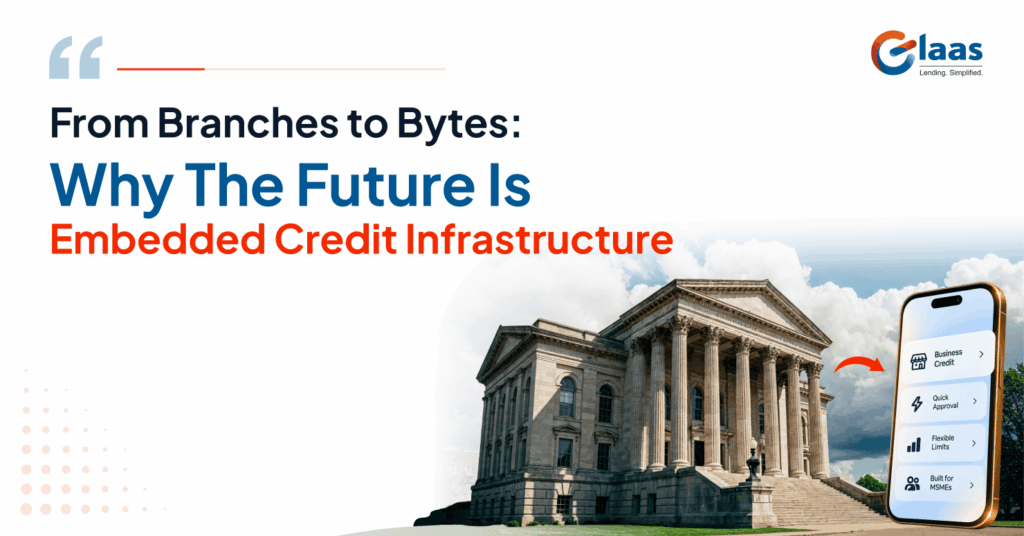
Only 14% of India’s MSMEs have access to formal credit. That leaves a staggering ₹25 lakh crore credit gap.
I am not someone who likes to throw numbers around, but this one captures the scale of the problem I want to solve next.
With a great team beside me, I spent 15 years building Fusion Finance, from the ground up to a public listing in 2022. When I stepped away in 2025, I began asking myself a fundamental question: How do we serve India’s MSMEs better, at scale, without simply replicating the traditional lending model?
Where the Traditional Branch-Led Model Strains
At Fusion, we built a network of nearly 1,500 branches, around 15,000 people and 4 million clients. That scale taught me a great deal about both the strengths and limitations of branch-led lending.
1. Constraints of physical distribution
Branch-led growth requires people, physical infrastructure and continuous investment. Ground-level attrition adds to the challenge, while reliance on Direct Selling Agents (DSAs) creates another vulnerability. DSAs work with multiple lenders and naturally direct business towards whoever offers the best incentive.
The paradox? The person closest to your customer may not be working in your interest.
2. The product-fit problem
MSMEs are anything but standard. Their credit needs depend on business cycles, cash flows, inventory and growth opportunities. Yet traditional lending often relies on standardised products.
As Finance Minister Nirmala Sitharaman observed at SIDBI’s 37th Foundation Day, “Standard products cannot serve non-standard businesses.”
I saw this firsthand. When borrowers outgrew our products, they often moved elsewhere.
We needed a fundamentally different approach.
From “Apply” to “Embedded”
I wanted my next venture to be relevant not just today, but 7-10 years from now. That meant challenging some of the very assumptions that had served me well in the past.
I went back to the field, spoke to MSME owners and commissioned a study examining lending opportunities across asset classes, including gold loans and loans against property (LAP).
Two developments stood out:
- India’s digital public infrastructure: Aadhaar, UPI, GST networks and digitised financial records were making identity verification, transaction visibility and credit assessment increasingly digital.
- The rise of business platforms: B2B marketplaces and software platforms were digitising orders, invoices, payments and other everyday business activities.
Together, these developments pointed to a new possibility: credit could be offered at the point of economic activity, instead of waiting for the borrower to approach a lender.
The study captured the opportunity clearly: “The next generation of lending growth will come from platforms, partnerships and personalisation at scale.”
My conclusion was clear: the future of MSME lending lies not just in reaching borrowers, but in embedding credit into the platforms where they already do business.
Credit Is Becoming a Flow Business
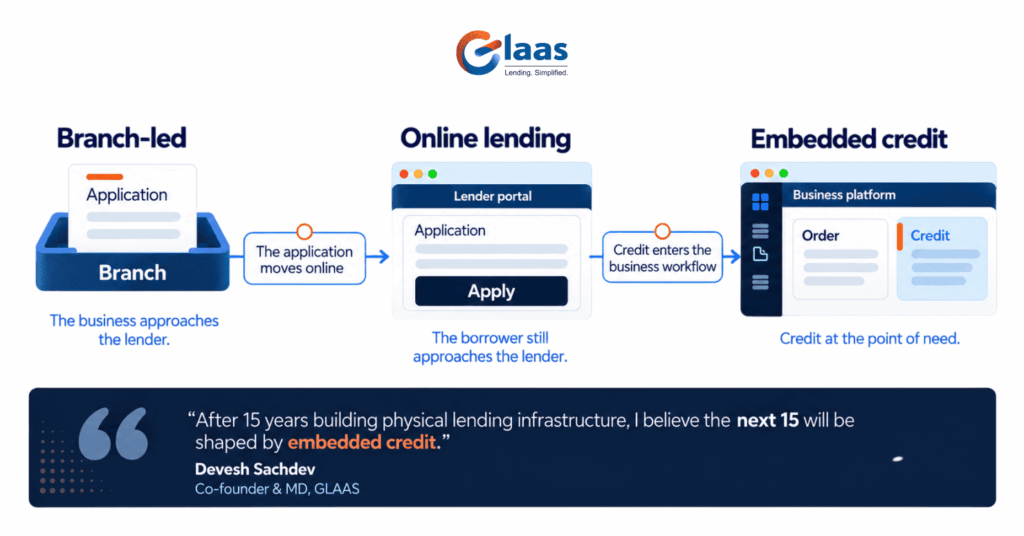
The difference between traditional digital lending and embedded credit comes down to timing.
- Apply: The borrower must stop what they are doing and approach a lender.
- Embedded: Credit is available when the business need arises, within the platform the borrower already uses.
An invoice is raised. An order comes in. Inventory needs replenishing. A cash-flow gap emerges.
These are the moments when working capital matters most. Waiting for a borrower to visit a lender weeks later can mean missing the opportunity altogether.
India’s TReDS ecosystem shows what digital credit infrastructure can do. Financing volumes grew from around ₹40,000 crore in FY22 to ₹3.47 lakh crore in FY26.
Research on counter-credit practices among Mumbai’s neighbourhood grocery stores offers another insight: when credit was available at the point of purchase, customer retention rose from 74% to 92%.
The principle is simple: credit delivered at the right moment can create value for both the borrower and the business serving them.
What Does Truly Embedded Credit Look Like?
The term embedded finance is used loosely. For me, the test is straightforward: Can an MSME access, manage and repay its loan within the application it already uses to run its business, without breaking the journey?
Credit should fit naturally into the operating workflow. Where possible, repayments should align with business cash flows, and servicing should happen within the same digital environment.
The objective is not simply a better digital interface. It is a fundamentally better way to distribute, underwrite and service credit.
Why Infrastructure Matters
In 2020, Andreessen Horowitz’s Angela Strange popularised the idea that in future, every company would become a fintech company.
For MSMEs, I see a similar opportunity: every platform where businesses transact could become a channel for credit.
But a marketplace or SaaS company should not have to build an entire lending operation or acquire a banking licence to serve its customers.
It needs the right infrastructure underneath.
That realisation brought me to GLAAS.
I saw an opportunity to combine the reach of digital platforms with the capabilities of regulated lenders through a common technology and data infrastructure. GLAAS connects platforms, Lending Service Providers (LSPs), lenders and co-lenders, enabling credit to be distributed through existing business ecosystems.
The ambition is to address two structural constraints I experienced at Fusion: the cost of distributing through people and branches, and the limits of standardised products.
Technology at the infrastructure layer can help lower acquisition and servicing costs, improve underwriting through richer data, and enable more relevant credit products.
The larger opportunity is to make credit a seamless part of how MSMEs operate, not another process they must navigate.
My Next Move
The next phase requires a different mindset: less dependence on physical distribution, greater use of data, deeper platform partnerships and technology designed around the borrower’s business.
I am not moving away from lending. I am rethinking the architecture through which lending reaches customers.
After 15 years of building physical lending infrastructure, I believe the next 15 years will be shaped by embedded credit infrastructure.
That is why GLAAS.
Devesh Sachdev is co-founder and Managing Director of GLAAS. He has spent over 25 years widening access to credit for underserved borrowers, with a long track record in microfinance. He studied at XLRI. His writing draws on that experience of lending to people and businesses that formal credit has often skipped.
All articles →