I recently wrote how the line between retail and corporate credit is breaking down and how the phenomenon of category erosion is fundamentally rewriting the economics and operational playbook of financial institutions.
After publishing it, I had a good discussion about what changes next.
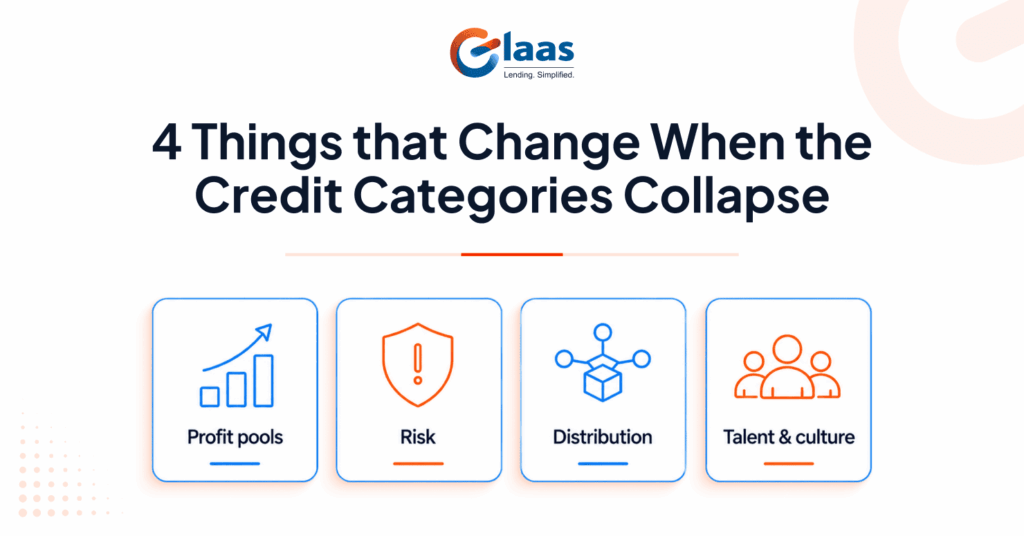
Well, 4 things in my opinion and here’s what can be done about them:
The Collapse of Traditional Profit Pools
Historically, banks were required to charge high fees and have wider margins on corporate/MSME lending because of the “bespoke manual processing”. As MSME lending automates, those operational margins are collapsing. Conversely, retail yield is under pressure, forcing institutions to find new revenue streams.
Risk Assessment Shifts from “Static Assets” to “Live Data Flows”
Traditional corporate lending relies on trailing financial statements (GST returns, balance sheets, ITRs). Retail relies on credit scores. Category erosion forces a shift toward Transaction-Based Underwriting. Because an MSME’s position changes faster than its filings do. Risk has to be read from current cash flow and platform sales, not from documents describing last year.
Distribution is Fragmenting
Traditional banks are losing direct ownership of the customer interface. When an MSME can get a working capital loan instantly inside their accounting software or their B2B sourcing marketplace, they have no reason to visit a bank’s portal. The bank is relegated to a utility backend.
The Talent and Culture Mismatch
Bank organisational charts are deeply siloed. Retail product managers don’t understand complex business cash-flow cycles, and corporate relationship managers don’t understand how to design frictionless, 2-click UI/UX. All of this slows down product innovation.
What Can Financial Institutions and Fintechs Do?

For starters, they must transition from a product-centric silo model to a layer-centric platform model. But that isn’t all:
1. Adopt a “Lending-as-a-Service” (LaaS) Architecture
Instead of forcing business users to come into your siloed retail or corporate channels, export your balance sheet into the ecosystems where businesses already live.
The Play: Partner with an embedded credit provider, or build it in-house. By decoupling the manufacturing of credit (balance sheet, compliance) from the distribution (APIs embedded in B2B/SaaS platforms), you can deliver institutional-grade capital with retail-like seamlessness.
2. Unify the Core Data Layer
To serve the “individual acting like a corporation” or the “MSME wanting retail simplicity,” a bank must have a single, unified view of the customer. For instance, a proprietor’s business account and his personal account sit under the same PAN. Most banks still assess them as two unrelated customers, with separate risk profiles and separate limits.
The Play: Break down internal data silos. The data to fix this exists. What’s missing is the decision to treat it as one relationship, which is a policy call, not a systems upgrade.
3. Transition to Contextual & Programmatic Lending
Stop selling static loan products (e.g., “3-year term loan”) and start offering dynamic credit lines that embed directly into the user’s business cycle.
The Play: Develop rule-based, programmatic credit. For instance, a business’s credit limit should automatically scale up when their marketplace sales spike, and automatically sweep funds to repay the loan when invoices are settled, mimicking corporate treasury logic but executing with retail automation.
4. Re-engineer Risk with Alternative Data Pipelines
Since traditional credit history might be thin for emerging gig-workers or micro-merchants, risk frameworks must adapt to alternative data.
The Play: Build underwriting engines that hook directly into e-commerce merchant dashboards, logistics data, payments aggregators, and cash-flow vectors. This allows you to assess a commercial borrower with the speed of a retail algorithm.
In a nutshell… The old question was: ‘What documents can you show me?’
The new one is: ‘What does your money actually do in a given month?’